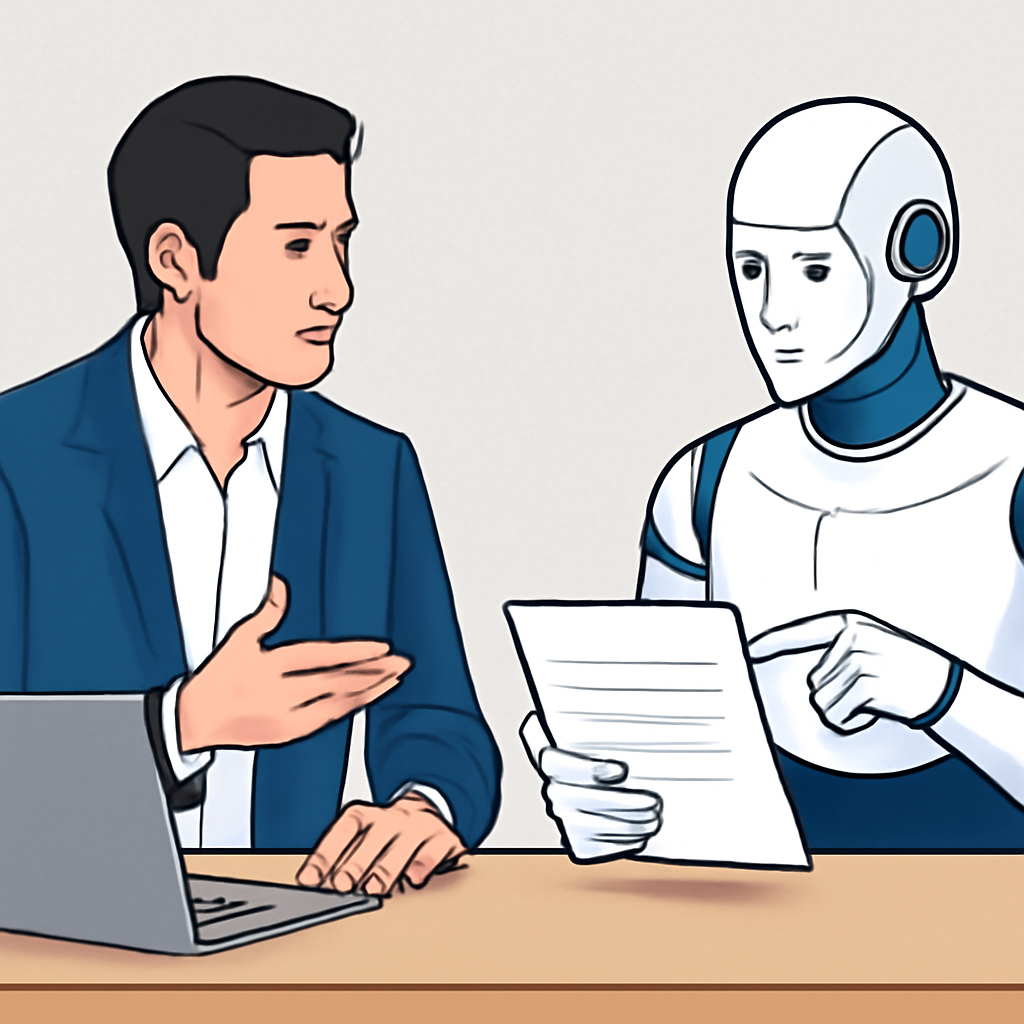
Cofounder as Assertive Partner: Why Your Commercial AI Should Propose, Not Ask
You open a chat window. You describe your situation — your product, your target customer, what you've tried so far. The AI responds with a thoughtful answer. You close the tab. Nothing moves.
That pattern is the problem with AI in a commercial role. Not the answer quality. The structure.
---
Most AI tools are waiting for you — and that's the problem
Every major AI tool on the market shares the same operating model: you ask, it answers. That's the product. You bring the context, you frame the question, you decide what to do with the output. The AI is a faster, smarter keyboard — but you're still the operator.
For writing a blog post or debugging a function, that's fine. You know what you want. You ask for it.
For go-to-market, it breaks down entirely.
GTM isn't a series of discrete tasks you can hand off one at a time. It's a continuous discipline — positioning that needs to sharpen as you learn, a pipeline that needs attention before prospects go cold, a content cadence that drifts the moment nobody's watching it. A reactive tool can't manage any of that, because by definition it's waiting for you to notice the problem first.
And here's the thing: you're a technical founder. Commercial pattern recognition isn't your background. You don't have a second operator cross-checking the things the AI missed. If the AI is waiting for you to ask the right question, the right question often never gets asked.
A real cofounder doesn't wait. They walk in Monday morning with a position.
---
What "assertive" means in a commercial context
Assertive AI isn't AI that acts autonomously. That's a different thing — and a different problem.
Assertive means: the AI holds the full picture, forms a view, and surfaces it without being asked. You still approve. You still decide. But you're not the one who has to notice the gap first.
Concretely, Cofounder is designed to work this way. Rather than waiting for you to ask "what should I write this week?", it proposes the content calendar based on your ICP, your current positioning, and the cadence you've agreed on. Rather than waiting for you to notice that your messaging has drifted, it's built to surface tensions it detects between your stated foundation and your recent decisions — flagging them for you to resolve before they compound into a real problem. Rather than waiting for you to audit your ICP definition, it tracks whether your outreach patterns are consistent with who you said you were selling to.
The key distinction is worth repeating: assertive is not autonomous. The proposal-to-approval gate is a design principle, not a limitation. Cofounder is built to propose; you confirm, adjust, or reject before anything goes out into the world. That's the loop. It keeps you in control without making you the one doing all the cognitive work of knowing what to propose in the first place.
---
Why "asking the AI" is a category error
Imagine you hired a head of marketing. Experienced, smart, knows your business. And then you only ever spoke to them when you filed a support ticket.
You'd get good answers. They'd respond thoughtfully. But they'd never tell you the ICP you've been targeting is too broad. They'd never notice the content angle you've been hammering has run its course. They'd never flag that the prospect you've been nurturing for six weeks just went quiet.
You'd have the right person in the wrong model.
The same applies to AI in a commercial role. Treating a commercial AI as a Q&A tool is a category error. It's not a question of capability — it's a question of structure. Reactive AI puts the burden of commercial judgment back on you: you have to know what to ask, when to ask it, and how to interpret the answer. That burden is exactly what you can't afford.
The commercial domain requires continuous attention. Not because marketing is complicated. Because it's ongoing — and the gap between where you are and where you need to be widens the moment no one's watching it.
A reactive tool can't catch drift. Only something that's watching continuously — and is willing to tell you what it sees — can.
This is why persistent context isn't a nice-to-have feature. It's the prerequisite for assertiveness. You can only propose the next move if you remember every previous one. A tool that starts from zero each session can't hold a position, because it doesn't know what position was held before. Assertive behaviour is structurally impossible without memory that accumulates and a reasoning layer that acts on it.
---
The anatomy of a useful proposal
There's a meaningful difference between a prompt response and a well-formed proposal. It comes down to four things.
Grounded in context. A useful proposal references what's already happened — the decisions already made, the pipeline's current state, the ICP you've committed to. Not generic best practice. Your specific situation.
Has a rationale. "You should post on LinkedIn this week" is noise. "Your ICP-pain cluster hasn't had a post in 10 days, and Monday is your highest-performing slot" is signal. The rationale is what makes the proposal actionable rather than arbitrary.
Has a concrete next action. Not "consider exploring content on this topic." Draft this. Send that. Publish here. The output of a useful proposal is something you can approve or reject — not something you have to translate into a task first.
Is confirmable, not irreversible. The founder reviews before it ships. That's the gate. The value isn't that the AI makes the call — it's that the AI does the thinking so the founder can make the call faster, with better information, without starting from scratch.
Consider what this looks like for something as routine as a content brief. In a reactive model, you open a chat, describe your product, explain your audience, name the topic you had in mind, ask for help structuring it. You're doing the work of framing the problem before you even get to the problem. In an assertive model, the brief is already there — grounded in your ICP, attached to the right cluster, structured for the right channel — and your job is to approve it, sharpen it, or redirect it.
The cognitive load difference is not marginal. It compounds across every decision, every week.
---
What this looks like week to week
Say it's Monday. You don't open a chat and ask what to write. Cofounder is designed to surface a proposed LinkedIn angle for the week — grounded in your ICP's current pain, calibrated against what's already been published, consistent with the positioning you've committed to. Your job: approve it, adjust the angle, or redirect.
Tuesday, the blog draft is queued. Not drafted from a blank prompt — produced from an approved brief that was already aligned to your content clusters and keyword strategy. You review it. You approve or request changes. It doesn't publish until you say so.
Mid-week, something flags. A prospect who's been in the pipeline has gone cold — no activity in a while, sequence stalled. Cofounder is designed to surface that rather than wait for you to notice it missing.
Friday, the week closes. The cadence held. Not because you were vigilant about it. Because the system was.
That's the shift. Your job isn't "what should I do next?" Your job is approve, reject, adjust. You're the decision-maker, not the orchestrator. For a founder with finite engineering bandwidth and no commercial team, that distinction is the difference between GTM that moves and GTM that stalls.
---
Why the AI tools market got this wrong
The dominant AI tool paradigm is Copilot: helpful on demand, reactive by design. You ask, it helps. That model is safe to ship. If the tool waits and you don't ask the right question, that's on you — the tool did its job.
The model optimised for safety, not for the use case. In a consumer context, a text editor or coding assistant, reactive is appropriate. You know what you want to write or build. The tool helps you do it faster.
In a commercial context for a solo founder, reactive is failure. There's no second operator. There's no marketing lead who catches the drift. The solo founder's commercial operation lives or dies on whether important things get noticed before they become expensive. A tool that waits cannot provide that. It can only amplify the thinking you already did.
Cofounder's counter-position is structural: in a commercial role, waiting is a failure mode. The solo founder without a commercial team can't afford a partner who only speaks when spoken to. That's not what a cofounder is.
---
The standard worth holding your AI to
Here's a simple test. Does your AI know what you should be doing next in your go-to-market — without you telling it?
If the answer is no — if it needs you to bring the context, frame the question, and interpret the answer — then it's a tool. A useful one, possibly. But a tool.
A cofounder holds the context. A cofounder has a position. A cofounder tells you what they think before you ask.
That's the standard. It's also the design principle Cofounder is built around.
---
See what an assertive commercial AI actually looks like in practice — start free, no card required.